Stage 7 of 20
Self-Mastery
Govern your thoughts, emotions, desires, and attention before you try to govern circumstances.
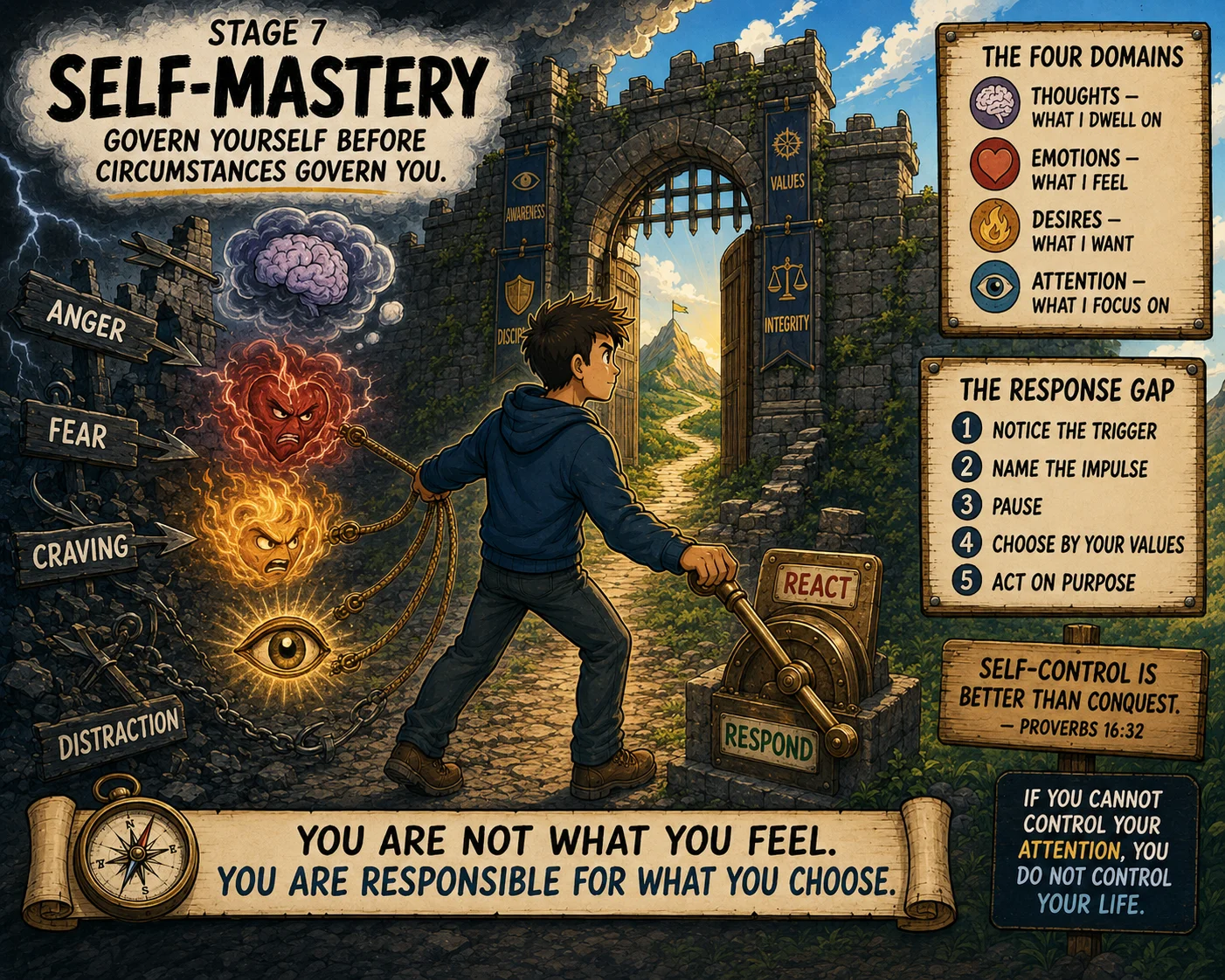
Core Question
Can I govern myself?
What This Stage Teaches
- The difference between what you feel and what you choose
- You can know your purpose and believe in it while still being controlled by impulses, moods, or distraction
- The stimulus-response gap: you're angry, but you don't have to act angry; you're afraid, but you don't have to obey fear
- The four domains of self-mastery: thoughts, emotions, desires, and attention
- If you cannot control your attention, you don't really control your life
- Self-control is valued above conquest (Proverbs 16:32)
Skill to Develop
Widening the gap between stimulus and response: noticing an impulse, emotion, or craving, and choosing your response instead of being run by it.
The Biblical Framework
-
GUARD YOUR WALLS
“He whose spirit is uncontrolled is like an unwalled town which has been broken into.”
Proverbs 25:28 -
VALUE SELF-RULE ABOVE CONQUEST
“He who is slow to be angry is better than a man of war, and he who has control over his spirit than he who takes a town.”
Proverbs 16:32 -
DISCIPLINE YOUR BODY, NOT JUST YOUR MIND
“But I give blows to my body, and keep it under control, for fear that, after having given the good news to others, I myself might not have God's approval.”
1 Corinthians 9:27
Hill vs. Scripture
Hill
Master your mind so that your thoughts serve your definite purpose.
Scripture
Master yourself because self-control is part of becoming a wise, faithful person, not merely a tool for getting what you want.
The Hard Questions
- What impulse controls me most?
- What emotion most often hijacks my decisions?
- Where do I repeatedly choose short-term pleasure over long-term benefit?
- What distraction consumes disproportionate attention?
- What do I keep saying I will do but repeatedly fail to do?
- If someone observed my behavior for 30 days, what would they conclude I actually value?
Exercise
The Impulse Journal
For seven days, record trigger, impulse, action, and consequence for one recurring pattern (for example: customer criticism, anger, defensive response, damaged relationship). Then write the better response you'll try next time. You're teaching yourself to notice the gap between stimulus and response.
SELF-MASTERY: Learn to govern your thoughts, emotions, desires, and attention so your choices are directed by values and purpose rather than by whatever you happen to feel.
Stories for This Stage
From Scripture
Joseph is running Potiphar's household with real authority and trust when Potiphar's wife starts propositioning him, day after day, with essentially no chance of being caught. He refuses every time. When she finally corners him alone and grabs his cloak, he leaves the cloak in her hand and runs from the house. "How could I do this great wrong and sin against God," he says, choosing the immediate, humiliating cost of fleeing over the private, undetectable option of staying. It costs him: she lies about him, and he's thrown into prison anyway despite doing the right thing. Self-mastery, here, isn't a feeling. It's what he does with his body in the ten seconds before the door closes. Genesis 39:6-12.
My Story
I wouldn't say I've mastered this one. But one area I've actually improved in, through real repeated practice, is how I handle being challenged. My instinct used to be to get defensive or shut down when someone pushed back on me, especially in tense conversations. That changed after I took a Crucial Conversations course back at Xerox. It was an eye opener, even though I haven't practiced it perfectly since.
One place it actually shows up is with unhappy customers. When a customer is upset, my old reaction would have been to get defensive, explain myself, protect my position. Instead I've learned to lean into the listening that already comes naturally to me, to actually hear what they're upset about before I respond, instead of reacting to being challenged.
It's not a switch I flipped once. It's something I still have to choose in the moment, conversation by conversation, and I don't always get it right. But the gap between getting criticized and how I respond to it has gotten wider than it used to be, and that's the part that's actually made a difference.