Stage 13 of 20
Persistence
Keep going through resistance, without becoming stupidly stubborn.
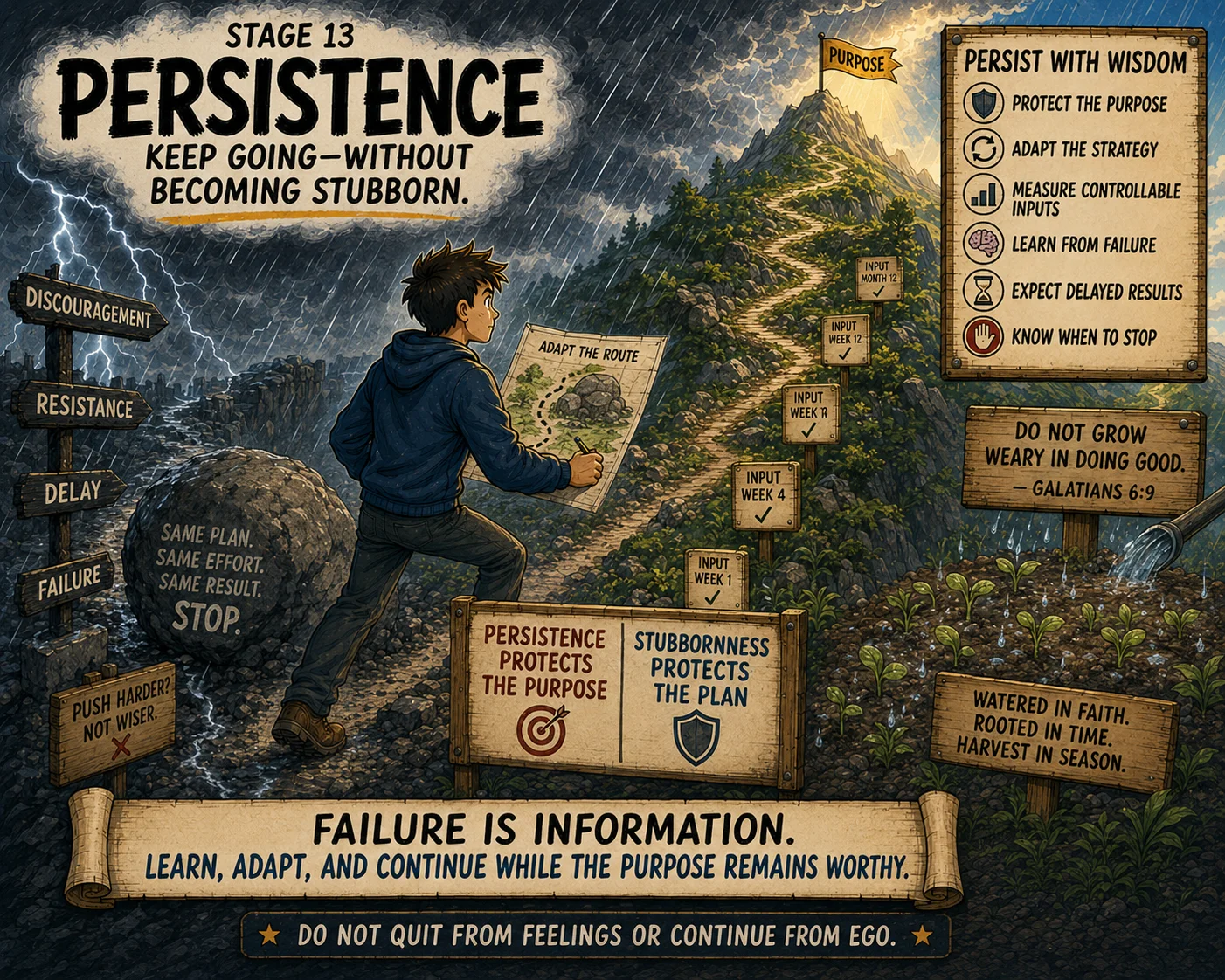
Core Question
What do I do when commitment becomes expensive?
What This Stage Teaches
- Persistence is not stubbornness: persistence protects the purpose, stubbornness protects the plan
- The Bible commands perseverance without promising an immediate harvest (Galatians 6:9)
- Results often lag behind effort: don't confuse lack of immediate results with lack of progress
- Persistence is easier when the purpose is strong (connects back to Stage 5, Desire)
- Persistence requires emotional control: most people quit from feelings, not facts (Proverbs 16:32)
- Expect resistance: important things are often difficult because they're important
- Failure is information, not just something to endure: persistent people learn, stubborn people repeat
- Perseverance builds character, not just outcomes (Romans 5:3-4)
- Don't rely on motivation: build systems that make continuing easier than quitting
- Persistence has a limit: know when quitting is wisdom, not failure
- Beware the sunk-cost trap: persistence should be based on future value, not past investment
- Measure the controllable inputs, not just the distant outcome
Skill to Develop
Continuing through resistance by controlling your emotional state and adapting your strategy, while knowing the difference between a worthy objective and a failed plan you're protecting out of ego.
The Biblical Framework
-
KEEP DOING WHAT IS RIGHT
“And let us not get tired of well-doing; for at the right time we will get in the grain, if we do not give way to weariness.”
Galatians 6:9 -
CONTROL YOURSELF, NOT JUST CIRCUMSTANCES
“He who is slow to be angry is better than a man of war, and he who has control over his spirit than he who takes a town.”
Proverbs 16:32 -
LET TRIALS PRODUCE CHARACTER
“And not only so, but let us have joy in our troubles: in the knowledge that trouble gives us the power of waiting; and waiting gives experience, and experience, hope.”
Romans 5:3-4 -
LET TRIALS PRODUCE MATURITY
“Let it be all joy to you, my brothers, when you undergo tests of every sort; because you have the knowledge that the testing of your faith gives you the power of going on in hope; but let this power have its full effect, so that you may be made complete, needing nothing.”
James 1:2-4
Hill vs. Scripture
Hill
Persistence is essential to converting desire into reality: don't quit.
Scripture
Persevere in what is good, but know what's actually worth not quitting. Refusing to abandon a bad pursuit because your ego can't tolerate being wrong looks like persistence too. Only one is wisdom.
The Hard Questions
- What am I about to quit simply because I'm uncomfortable?
- Where am I calling stubbornness "persistence"?
- What has failure taught me that I'm refusing to acknowledge?
- What small action can I continue doing regardless of how I feel?
- Am I continuing because the future still looks promising, or because I can't admit the past investment was wasted?
- What is this difficult season trying to develop in me?
Exercise
Decide the Evidence in Advance
For your current hardest pursuit, write down what evidence would tell you to continue, and what evidence would tell you the strategy needs to change. Deciding this in advance protects you from both quitting too early and persisting too long.
PERSISTENCE: Continue through resistance and delayed results, control your emotions rather than obeying them, learn from failure, and know the difference between perseverance and ego-driven stubbornness.
Stories for This Stage
From Scripture
Paul and Silas singing hymns in a Philippian jail after being beaten, still moving toward their purpose despite the setback (Acts 16:22-25). Acts 16:22-25.
My Story
After we lost the supplier and our top rep at the same time, the hard part wasn't the moment it happened. It was the season that followed. There were real stretches where I doubted whether the business would even survive. It wasn't one bad day, it was weeks of grinding without much to point to that said things were getting better.
Nothing about the facts had necessarily gotten worse in that stretch. We'd already made the decisions we needed to make, brought on another supplier, started rebuilding. But the discouragement didn't care what the facts said. It just sat there, day after day, whispering that maybe this wasn't going to work.
What actually got me through wasn't a breakthrough moment or a sudden turnaround. It was just continuing to show up and do the work, day by day, whether or not I felt like it that particular morning. There was no dramatic ending to the doubt. It just slowly lost its grip as the days added up and the business kept going, one ordinary day of work at a time.