Stage 16 of 20
Economic Value
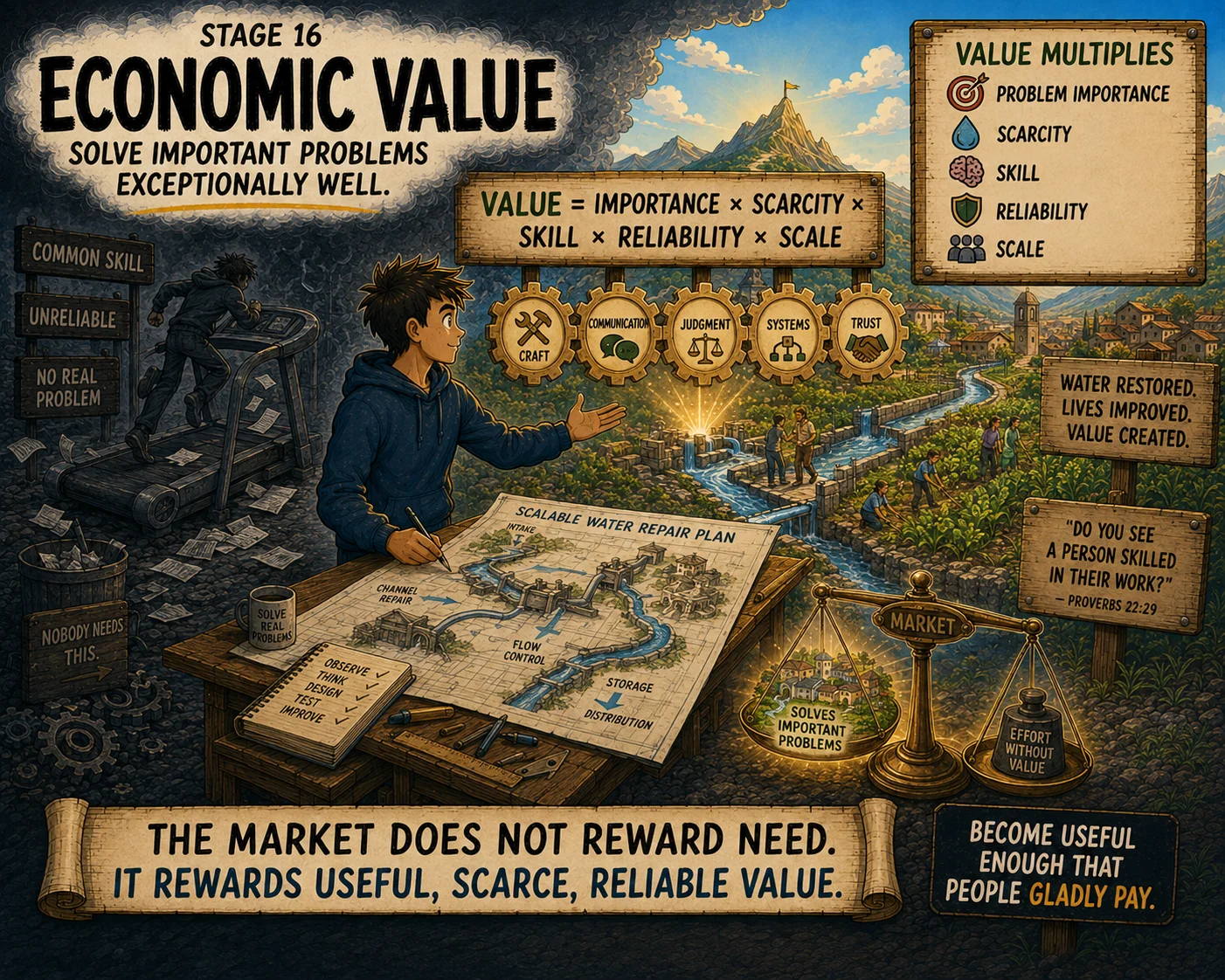
Become useful enough that the marketplace rewards you.
Core Question
What valuable problems can I solve?
What This Stage Teaches
- Before you can build wealth, you need something that produces economic value
- The market doesn't compensate need, it compensates value
- Economic value = problem importance x scarcity x skill x reliability x scale
- Hard work alone isn't enough; you can work incredibly hard at something nobody values
- Building a skill stack (combining several skills) creates a rarer, more valuable combination than any one skill alone
Skill to Develop
Identifying the specific, valuable problem you solve, and building the combination of skills that makes solving it scarce and reliable.
The Biblical Framework
-
SKILL OPENS DOORS
“Have you seen a man who is expert in his business? He will take his place before kings; his place will not be among low persons.”
Proverbs 22:29 -
WORK PRODUCES PROFIT WHEN IT'S AIMED AT SOMETHING VALUABLE
“In all hard work there is profit, but talk only makes a man poor.”
Proverbs 14:23
Hill vs. Scripture
Hill
Develop specialized knowledge and turn it into organized economic value.
Scripture
Work diligently, develop skill, and serve others through productive work, but economic value is not the same thing as human worth.
The Hard Questions
- If my current employer disappeared tomorrow, what economic value could I independently create?
- What problem am I exceptionally good at solving?
- How replaceable am I?
- What skill would make me significantly more valuable?
- Am I optimizing for effort or results?
- Am I becoming more valuable every year?
Exercise
The Value Inventory
List: problems I can solve, skills I possess, skills I'm developing, problems people already pay me to solve, problems that would be more valuable to solve, and the skill that would increase my market value most.
ECONOMIC VALUE: Become increasingly skilled at solving increasingly important problems so your contribution becomes scarce, useful, reliable, and economically valuable.
Stories for This Stage
From Scripture
The "excellent wife" of Proverbs 31 isn't praised for being decorative. She evaluates a field and buys it, plants a vineyard with her own earnings, trades profitably late into the night, makes and sells linen garments to merchants, and the text says her lamp doesn't go out at night, she's still working. Her value isn't abstract virtue; it's described in commercial, concrete terms, planning, producing, and trading well enough that the whole household benefits and she's praised in the city gate for it. Proverbs 31:16-18, 24.
My Story
When I started helping my cousin with his roofing company, one of the real problems I solved was building out a sales commissions and sub-contractor payments setup, tracked per job. That's not a problem you can solve with trade knowledge alone, and it's not one you can solve with tech knowledge alone either. It took understanding how commissions and job costs actually worked in that business, combined with the process thinking to build something that could track it accurately.
Neither piece by itself would have solved it. Someone with only the trade background wouldn't have known how to structure the tracking. Someone with only the tech background wouldn't have known what actually needed tracking or why it mattered to get it right.
What that taught me was where my actual value lies. It's not the trade knowledge and it's not the process or tech thinking on their own. It's being able to translate between those two worlds, understanding both well enough to build something that actually works for people living in one of them. That combination has shown up again and again since, and it's a big part of what Valverax is built on.