Stage 15 of 20
Leadership
Make other people better and more effective.
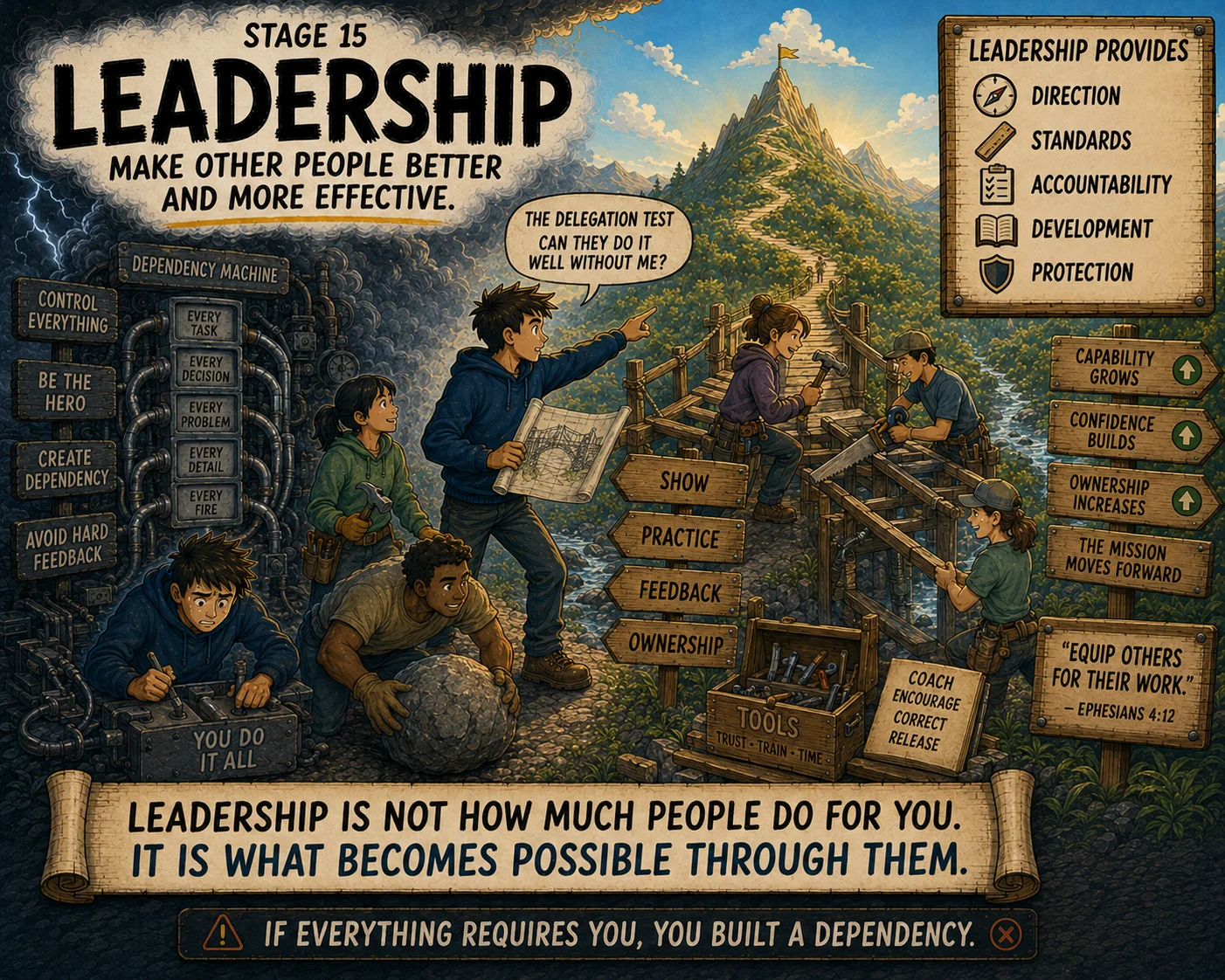
Core Question
Can I make others better?
What This Stage Teaches
- You can be an excellent individual contributor without being a leader
- Leadership requires vision, communication, judgment, accountability, courage, delegation, and developing others
- The leader doesn't ask "how can everyone serve me," but "how can my position help these people succeed"
- Five things leadership requires: direction, standards, accountability, development, and protection
- The delegation test: don't ask "how do I get them to do this," ask "how do I make this person capable of doing this without me"
- If everything requires you, you don't have a scalable organization, you have a dependency
- Leadership roles exist partly to equip others for their own work (Ephesians 4:11-12)
Skill to Develop
Measuring leadership not by how much you personally accomplish through people, but by what happens to the people because of your leadership.
The Biblical Framework
-
LEAD THROUGH SERVICE, NOT DOMINATION
“And Jesus made them come to him, and said to them, You see that those who are made rulers over the Gentiles are lords over them, and their great ones have authority over them. But it is not so among you: but whoever has a desire to become great among you, let him be your servant, and whoever has a desire to be first among you, let him be servant of all. For truly the Son of man did not come to have servants, but to be a servant, and to give his life for the salvation of men.”
Mark 10:42-45 -
EQUIP OTHERS FOR THEIR OWN WORK
“And he gave some as Apostles, and some, prophets; and some, preachers of the good news; and some to give care and teaching; for the training of the saints as servants in the church, for the building up of the body of Christ.”
Ephesians 4:11-12
Hill vs. Scripture
Hill
Organize people and cooperation toward achievement.
Scripture
Leadership is stewardship and service. The leader's authority exists partly to develop and serve others, not merely to accomplish more through them.
The Hard Questions
- Do people become stronger or weaker under my leadership?
- Do I delegate responsibility or merely tasks?
- Do I give people authority proportional to responsibility?
- Can people disagree with me safely?
- What decisions still depend unnecessarily on me?
- Who am I actively developing into a leader?
Exercise
The Delegation Test
For something only you currently do, ask: how do I make someone else capable of doing this without me? Write the specific steps you'd need to take to hand it off.
LEADERSHIP: Create direction, establish standards, develop people, remove obstacles, and use authority to help others become capable of meaningful work.
Stories for This Stage
From Scripture
The night before his crucifixion, Jesus gets up from supper, wraps a towel around his waist, and washes his disciples' feet, the specific, unglamorous task normally left to the lowest servant in a household. Peter objects; Jesus insists. Then he tells them plainly: if I, your teacher, have done this, you should do the same for each other. The most authoritative person in the room performed the least prestigious task in the room, on purpose, as the model for what leadership actually looks like. John 13:3-15.
My Story
For a long time, how we took detailed measurements and broke down materials for a job was entirely manual. It worked, but it was slow, and it quietly ate hours out of every single job without anyone really questioning it, because it was just how it had always been done.
Rather than expecting the team to keep pushing through it, I made the call to change the process and bring in a tool called Valor to handle it instead. That wasn't about defending how we'd always done things. It was about actually looking at what was standing between the team and doing their work well, and getting it out of the way.
Once it was in place, the difference showed up immediately. It saves many hours per job now, hours that used to go into manual measurement and material breakdowns. Nobody had to try harder or work faster. I'd just removed something that had been quietly costing the team time on every job. That's the part of leadership I keep coming back to: sometimes the most useful thing I can do isn't push people forward, it's clear out what's actually holding them back.