Stage 18 of 20
Intuition & Discernment
Make wise decisions when the data is incomplete.
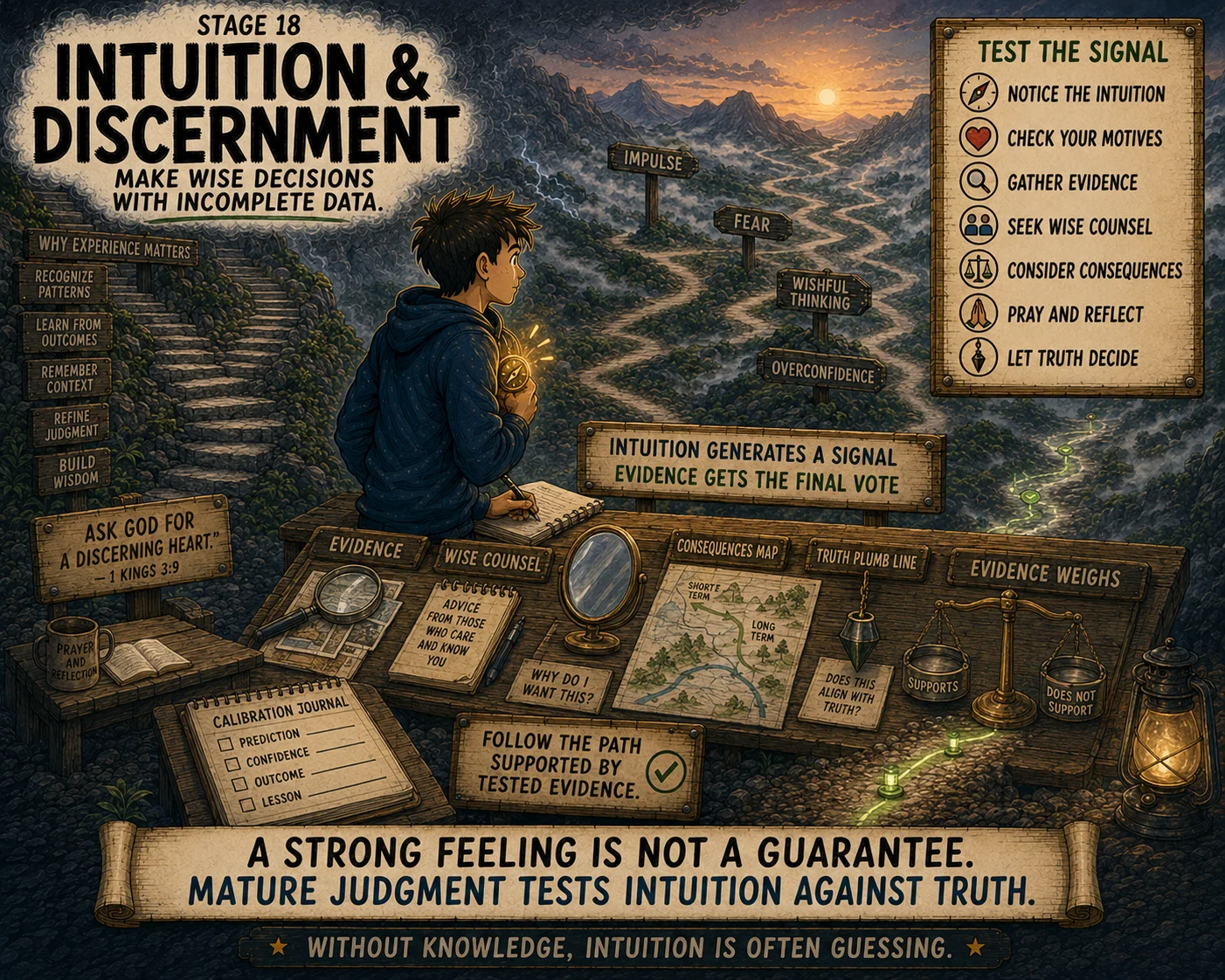
Core Question
Can I make wise decisions under uncertainty?
What This Stage Teaches
- Intuition isn't supernatural certainty, it's accumulated experience operating beneath conscious awareness
- An experienced person can sometimes recognize patterns before consciously articulating the reasoning
- Intuition generates a signal; evidence gets the final vote
- Discernment involves evaluating motives, consequences, character, truth, evidence, wisdom, and counsel
- Intuition shouldn't replace research, expert advice, evidence, prayer, and reflection, it should complement them
- This stage belongs late in the sequence because intuition without knowledge is often just guessing
Skill to Develop
Treating a strong intuition as a signal to investigate, not a conclusion to trust blindly, testing it against evidence before acting on it.
The Biblical Framework
-
ASK GOD FOR WISDOM, NOT JUST RICHES
“Give your servant, then, a wise heart for judging your people, able to see what is good and what evil; for who is able to be the judge of this great people?”
1 Kings 3:9 -
WISDOM COMES FROM GOD
“For the Lord gives wisdom; out of his mouth come knowledge and reason.”
Proverbs 2:6 -
DISCERNMENT IS TRAINED THROUGH PRACTICE
“But solid food is for men of full growth, even for those whose senses are trained by use to see what is good and what is evil.”
Hebrews 5:14 -
SEEK COUNSEL RATHER THAN TRUSTING YOUR GUT ALONE
“Where there are no wise suggestions, purposes come to nothing; but by a number of wise guides they are made certain.”
Proverbs 15:22
Hill vs. Scripture
Hill
Develop a sixth sense that can guide you beyond conscious reasoning.
Scripture
Seek wisdom, discernment, prayer, counsel, truth, and mature judgment. Don't elevate intuition above truth. A feeling can be useful, and a feeling can also be completely wrong.
The Hard Questions
- Do I confuse intuition with emotion?
- Do I call something "God's guidance" when I simply want it to be true?
- What domains have I developed enough experience to trust my instincts?
- Where am I overconfident despite limited knowledge?
- Do I seek disconfirming evidence?
- Who has permission to challenge my interpretation?
Exercise
The Intuition Calibration Journal
Whenever you have a strong intuition, write it down along with what you think you're noticing, your evidence, and your confidence level. Later, record the actual outcome and what you missed. After enough decisions, you'll learn whether your intuition is actually reliable in that domain.
INTUITION & DISCERNMENT: Develop mature judgment through knowledge, experience, reflection, prayer, evidence, and counsel, while treating intuition as a signal to investigate rather than unquestionable truth.
Stories for This Stage
From Scripture
Two women living together both claim the same living baby as their own after one child dies in the night. There are no witnesses, no evidence, nothing to examine, just two competing claims. Solomon orders a sword brought and proposes cutting the child in half, one half to each woman. The real mother immediately begs him to give the baby to the other woman instead, anything to keep it alive; the false claimant says to divide it. That reaction is the only evidence Solomon needed, and it's enough. Discernment here isn't extra data. It's reading what the situation itself reveals when you know how to look. 1 Kings 3:16-28.
My Story
I was interviewing a potential sales rep, and partway through the conversation something felt off, a small inconsistency I couldn't fully put my finger on or prove at the time. It wasn't obvious enough to reject him outright on gut feeling alone.
Instead of just trusting the instinct and walking away, I went through our actual values and the specific qualities that make someone a good teammate here, along with the ones that wouldn't be a great fit. I used that as the real test, not just the feeling I'd picked up on.
Going through it that way, he ended up self-selecting out. The instinct had picked up on something real, but it took actually testing it against something concrete, what we value and what fits, to confirm it rather than just acting on a hunch. That's the balance I try to hold onto now: the gut feeling is worth paying attention to, but it's the evidence that gets the final vote.