Stage 19 of 20
Contribution
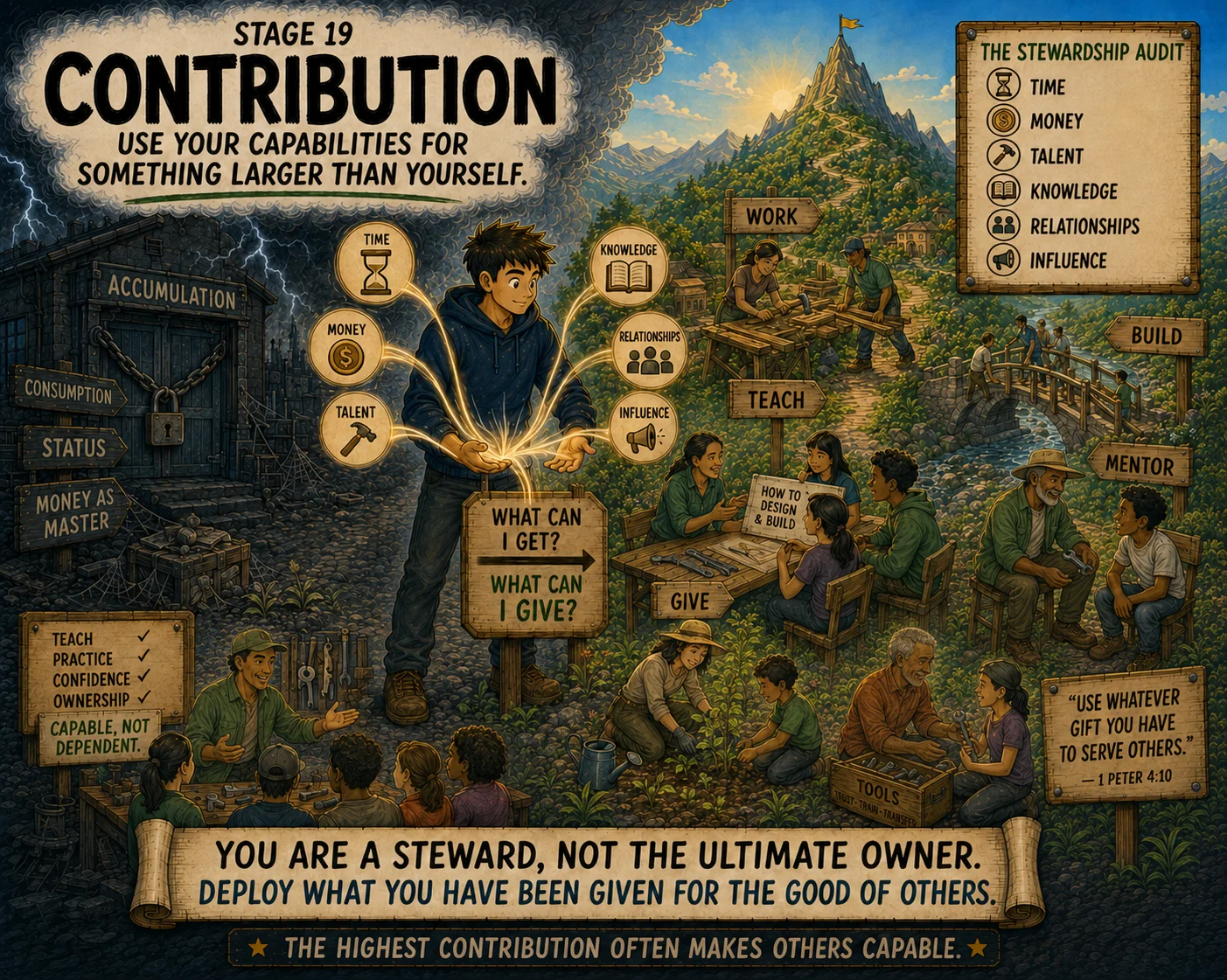
Use your capabilities for something larger than yourself.
Core Question
What can I give?
What This Stage Teaches
- You are a steward, not the ultimate owner, of your money, abilities, business, influence, relationships, knowledge, time, and opportunities
- The question shifts from "what can I get" to "what can I do with what I've been given"
- You don't control your starting position, but you are responsible for what you do with what's in your hands
- Productive work is part of human purpose, not merely a way to make money (Genesis 2:15)
- Wealth is a tool, not the goal; the issue isn't whether you can possess money, it's whether money possesses you (Matthew 6:24)
- Generosity is a discipline, not just an emotion: decide in advance what percentage of your resources you'll deploy for others (2 Corinthians 9:6-8)
- Contribution is bigger than charity: work, employment, teaching, mentoring, leadership, innovation, parenting, and community all count
- The highest form of contribution often isn't doing something for someone, it's making them capable of doing it themselves
Skill to Develop
Redirecting hard-won capability toward helping others achieve, treating your resources as something entrusted to manage well rather than something to merely accumulate.
The Biblical Framework
-
YOU ARE A STEWARD, NOT THE OWNER
“For it is as when a man, about to take a journey, got his servants together, and gave them his property, to everyone as he was able, and went on his journey. ... His lord said to him, Well done, good and true servant: you have been true in a small thing, I will give you control over great things: take your part in the joy of your lord. (excerpted from the fuller parable)”
Matthew 25:14-30 -
WORK IS PART OF STEWARDSHIP
“And the Lord God took the man and put him in the garden of Eden to do work in it and take care of it.”
Genesis 2:15 -
DON'T SERVE MONEY
“No man is able to be a servant to two masters: for he will have hate for the one and love for the other, or he will keep to one and have no respect for the other. You may not be servants of God and of wealth.”
Matthew 6:24 -
GIVE INTENTIONALLY
“He who puts in only a small number of seeds, will get in the same; and he who puts them in from a full hand, will have produce in full measure from them. Let every man do after the purpose of his heart, not giving with grief, or by force: for God takes pleasure in a ready giver. And God is able to give you all grace in full measure, so that ever having enough of all things, you may be full of every good work.”
2 Corinthians 9:6-8
Hill vs. Scripture
Hill
Turn achievement into contribution; the mature endpoint is service, not accumulation.
Scripture
You are a steward of what you've been given, not its ultimate owner. The question changes from how much you can get to what you can do with what you've been given.
The Hard Questions
- Am I still asking "how much can I get," or have I moved to "how much value can I create"?
- Who have I genuinely helped succeed, not just helped myself succeed?
- What capability do I have that's currently being hoarded instead of shared?
- What percentage of my resources deliberately goes toward helping others?
- Am I building wealth or merely consuming resources?
- What would change if I measured my success by what I gave rather than what I kept?
Exercise
The Stewardship Audit
For time, money, talent, knowledge, relationships, and influence, ask: where does this actually go? Then ask the brutal question: am I using these resources primarily for consumption or creation?
CONTRIBUTION: Recognize your time, money, abilities, and influence as entrusted resources, and deploy them for the benefit of others, not just your own accumulation.
Stories for This Stage
From Scripture
Boaz is under no legal obligation to notice Ruth, a foreign widow gleaning leftover grain in his field just to survive. He instructs his workers to leave extra stalks for her on purpose, invites her to eat with his own workers, and later, when she approaches him directly, takes on the costly, inconvenient role of family redeemer for her and her mother-in-law Naomi, resources, protection, and a future they had no claim to demand from him. He uses what he has, deliberately, for people who couldn't do anything for him in return. Ruth 2:8-16.
My Story
I gave someone without much experience a real shot at a sales rep role at Valverax, the kind of first chance that's hard to get without a track record already behind you. He did okay in it, but okay wasn't really the point. Along the way it became clear that sales wasn't actually where his strength was.
Instead of just leaving him in a role that was fine but not a fit, we changed it. He moved into a marketing role, shooting and editing videos for the company, and that's where he actually took off.
What mattered to me wasn't just giving him a job. It was paying attention to where he could actually succeed, even after the first opportunity wasn't the perfect match, and adjusting instead of writing him off. That's the part of contribution I keep coming back to: it's not just handing someone a chance, it's staying invested enough to help them find the one that actually fits.