Stage 20 of 20
Legacy
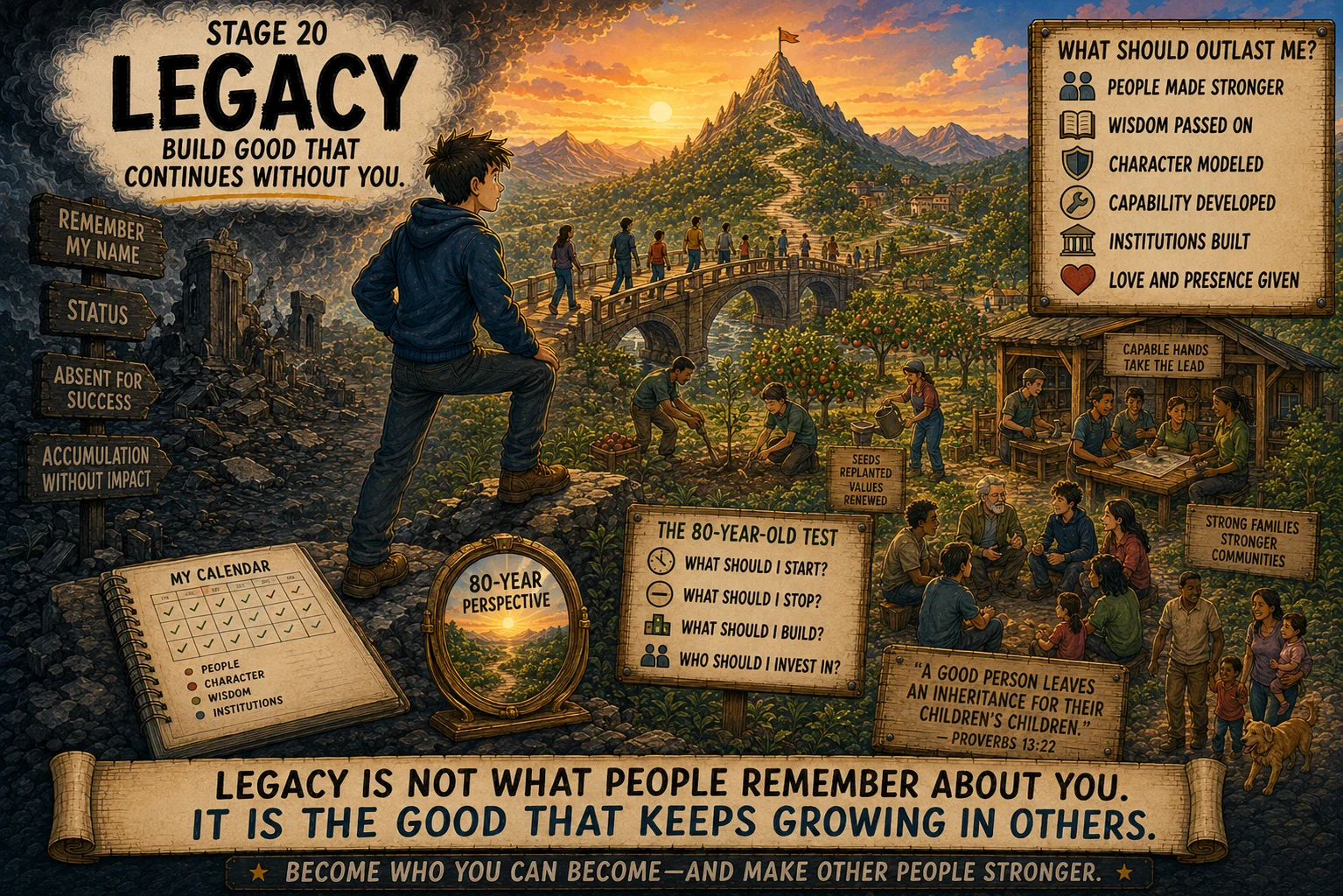
Leave something valuable that continues because you were here.
Core Question
What will remain because I lived?
What This Stage Teaches
- Legacy isn't "people remember my name," that's ego. Legacy is something valuable that continues because you were here
- More is given, more is required: greater capacity creates greater responsibility, not merely more privilege (Luke 12:48)
- A good person leaves an inheritance for their children's children, and inheritance isn't only money, it's wisdom, character, and capability too (Proverbs 13:22)
- A legacy isn't just what you leave behind, it's what people experienced from you; revenue doesn't determine legacy, impact does
- Time is your most irreplaceable resource; your calendar reveals what you actually prioritize, your stated values reveal what you claim to prioritize
- You can spend decades saying "I'm doing this for my family" while being almost completely absent from their life; that's not sacrifice, it's rationalized neglect
- Every meaningful contribution costs something; the question is what you're willing to sacrifice for something that matters more
- The final question isn't how much money you made or how many people knew your name, it's whether you became who you were capable of becoming and made other people stronger
Skill to Develop
Thinking in decades instead of days: asking what should still exist, who should still be benefiting, and what you're building now that outlasts your direct involvement.
The Biblical Framework
-
MORE IS GIVEN, MORE IS REQUIRED
“But he who, without knowledge, did things for which punishment is given, will get only a small number of blows. The man to whom much is given, will have to give much; if much is given into his care, of him more will be requested.”
Luke 12:48 -
LEAVE AN INHERITANCE FOR YOUR CHILDREN'S CHILDREN
“The heritage of the good man is handed down to his children's children; and the wealth of the sinner is stored up for the upright man.”
Proverbs 13:22
Hill vs. Scripture
Hill
Leave people, organizations, ideas, and institutions better than you found them.
Scripture
Store up treasure that doesn't rust or get stolen. Legacy is measured in what outlasts you in other people, not in what you personally accumulated.
The Hard Questions
- If I stopped working today, what would keep going without me?
- Who is better off because I invested in them specifically?
- What am I building that only I can operate, versus what I'm building that can outlast me?
- Am I sacrificing my family for a legacy they never asked for?
- If I died tomorrow, what unfinished responsibility would I most regret?
- If nobody ever knew my name, would I still consider the life I'm building worthwhile?
Exercise
The 80-Year-Old Test
Imagine yourself at 80, looking backward. What would that version of you wish you had started, stopped, built, learned, given, said, protected, or prioritized? Compare those answers with your current calendar.
LEGACY: Measure your life by what continues to produce good in other people after you're no longer the one doing the work.
Stories for This Stage
From Scripture
When it's time for Elijah to be taken up, Elisha asks for a double portion of his spirit, essentially asking to carry the work forward and then some. Elijah's mantle falls to him, and Elisha goes on to perform even more recorded miracles than his mentor did. Elijah's legacy wasn't the mantle itself. It was that he'd spent years pouring into a successor capable of continuing, and eventually exceeding, what he'd started. 2 Kings 2:9-15.
My Story
As a teenager in Rochester, my neighbors invited me to a youth group at their church. The youth pastor there made a point of reaching out to the youth of the city, including me, and taught us in the ways of God. He had no obligation to invest in a random teenager from the neighborhood, but he did it anyway, consistently, over time.
What that left behind wasn't just a memory. It was character and values that still guide the decisions I make today, decades after that pastor's direct involvement in my life ended. I couldn't point to a single lesson or sermon that did it. It was the whole of that steady investment, made in a season when I was still becoming who I'd end up being.
Now I find myself trying to pour that same thing into my own kids, and indirectly into everyone around me, especially the people at my company. Not because I have to, but because someone once did it for me without needing anything back. If any of it outlasts my own direct involvement, in my kids' lives or in the people I work alongside, the way that pastor's outlasted his in mine, that will have been worth far more than anything else I build.