Stage 9 of 20
Imagination
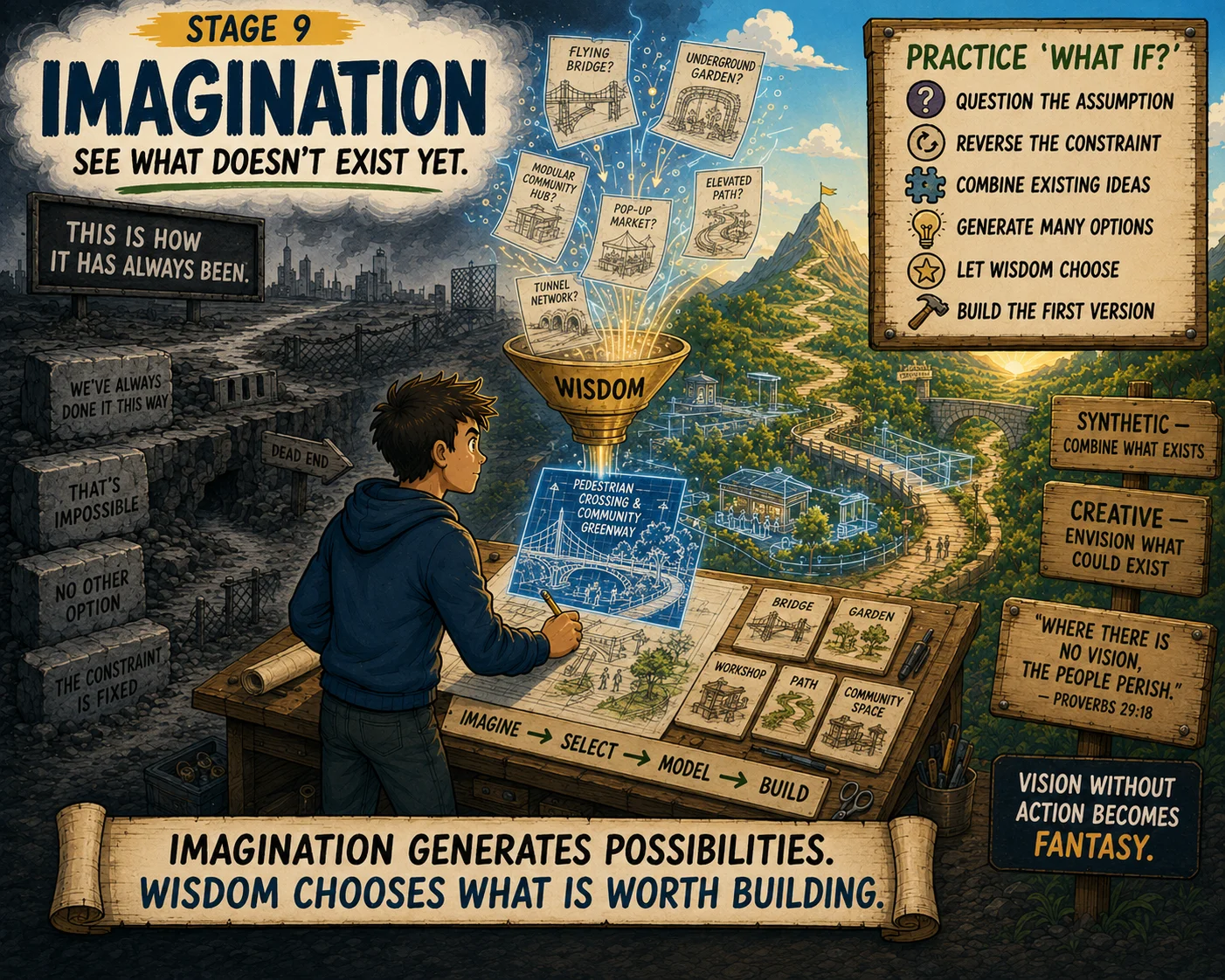
See what doesn't exist yet, before you try to build it.
Core Question
What could exist?
What This Stage Teaches
- Knowledge tells you what exists; imagination asks what could exist
- Synthetic imagination: combining existing ideas in a new way
- Creative imagination: generating genuinely new ideas or possibilities
- Most practical innovation begins with synthetic imagination, a better combination of existing things, not invention from nothing
- Without imagination, you're trapped by what currently exists
- Not every imagined possibility deserves pursuit; imagination generates options, wisdom chooses among them
Skill to Develop
Deliberately asking "what if": what if this process were redesigned, this problem solved another way, this constraint didn't exist?
The Biblical Framework
-
TRUST WHAT YOU CANNOT YET SEE
“Now faith is the substance of things hoped for, and the sign that the things not seen are true.”
Hebrews 11:1 -
HOLD A VISION
“Where there is no vision, the people are uncontrolled; but he who keeps the law will be happy.”
Proverbs 29:18 -
RECOGNIZE THE POWER OF COORDINATED INTENTION
“And the Lord said, See, they are all one people and have all one language; and this is only the start of what they may do: and now it will not be possible to keep them from any purpose of theirs.”
Genesis 11:6
Hill vs. Scripture
Hill
Imagination is an instrument for converting desire into achievement.
Scripture
Vision should be subordinate to wisdom, truth, and God's purposes. Not every imagined possibility deserves pursuit; imagination generates options, wisdom chooses among them.
The Hard Questions
- What future am I currently unable to imagine?
- What assumption am I treating as a fact?
- If I couldn't use my current solution, what would I try?
- What would I build if failure were impossible?
- What part of that vision could actually be pursued?
Exercise
The Constraint-Reversal Exercise
Take a problem and write: "This is impossible because..." List every constraint. Then ask: "What if that constraint didn't exist? What would I build? Which part of that imagined solution can actually be created?" This is how imagination becomes useful rather than fantasy.
IMAGINATION: Learn to envision possibilities beyond current reality, combine ideas creatively, and mentally construct better futures before attempting to build them in the real world.
Stories for This Stage
From Scripture
God takes Abram outside and tells him to look up at the night sky and count the stars, if he can. "So shall your offspring be," God tells him, an old man with no children yet, being asked to hold an image of a future that had no visible evidence behind it at all. Abram believed it, and the text treats that act of imagination, seeing a reality that didn't exist yet, as the foundation of everything that followed for him. Genesis 15:5-6.
My Story
Before Valverax had much reality behind it at all, I could already picture what it would become: a real office, a warehouse, people actually working within it, not just me figuring things out alone. That picture existed very early, even before we started, back when none of it was true yet.
It wasn't a wish so much as an image I kept coming back to. Part of that picture was a real team, not just an office and a warehouse standing empty, but many sales reps and ops people actually working inside it. I didn't know exactly how we'd get there, but I could see the shape of it clearly enough to work toward.
Today what we have is different in the details from what I originally pictured. The specific office, the specific warehouse, the size of the team of reps and ops people, none of it is exactly what I imagined back then, but the essence of it is there. A humble version of each piece exists now, built out of a picture that started with nothing behind it except the willingness to imagine it before it was real.