Stage 10 of 20
Decision
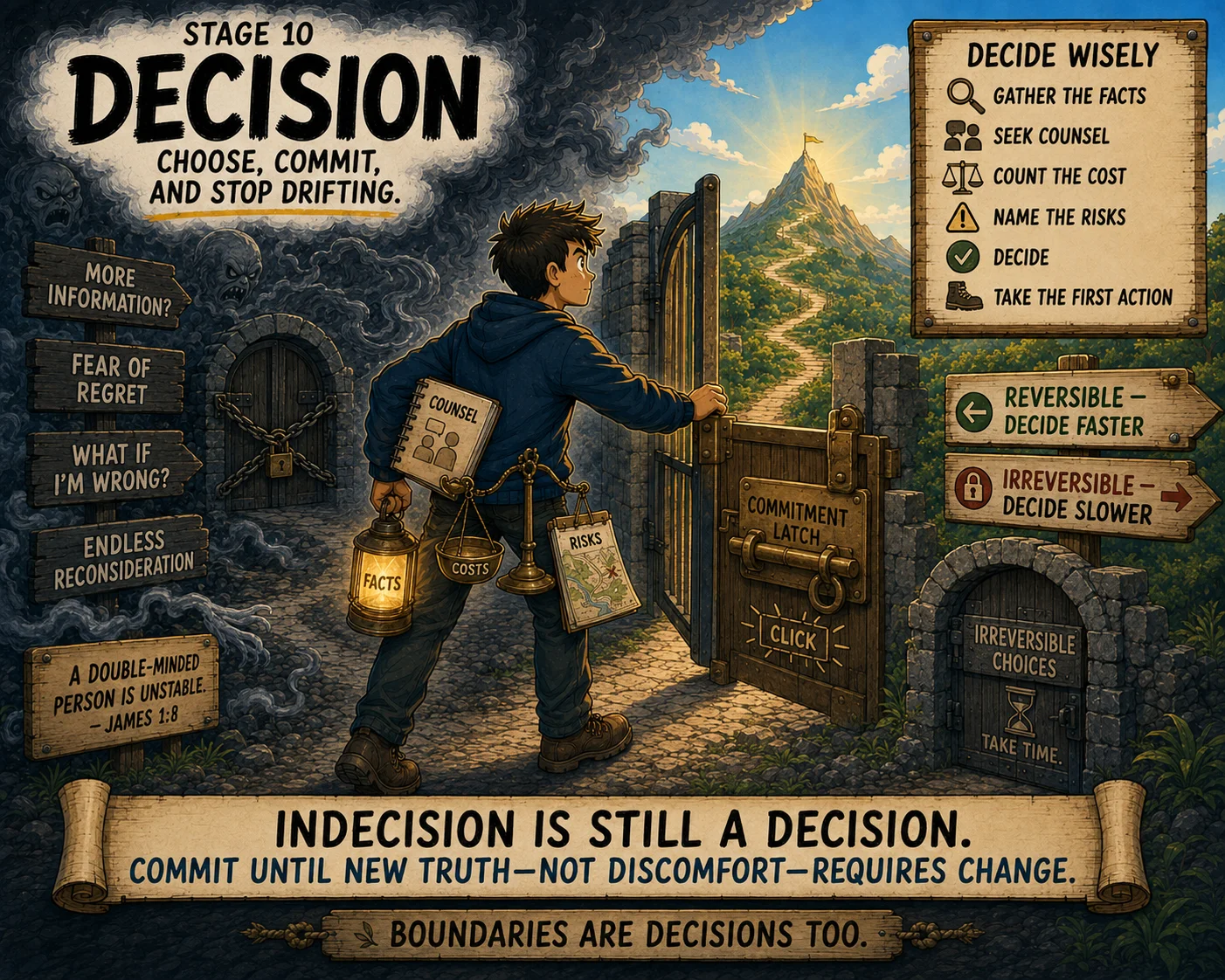
Choose, commit, and stop drifting: indecision is itself a decision.
Core Question
Can I make a sound decision, commit to it, and stop endlessly reopening it out of fear?
What This Stage Teaches
- Indecision is a decision: nothing changes while you "still decide" (James 1:6-8)
- Wisdom comes before the decision: gather facts, seek counsel, consider consequences, then decide
- You don't need perfect information: distinguish known, unknown, assumption, risk, and decision
- Decision speed should depend on reversibility: move fast on reversible decisions, slow down on irreversible ones
- Fear often hides inside indecision, disguised as "needing more information"
- A decision converts an aspiration into an identity and a responsibility
- Once decided, stop re-deciding: don't let temporary discomfort trigger reconsideration
- But don't become stubborn: change when new information, not discomfort, requires it
- Decision is also about what you will refuse to do: boundaries are decisions too
Skill to Develop
Making a sound decision with available information, committing to it, and distinguishing new information that should change your mind from discomfort that shouldn't.
The Biblical Framework
-
GATHER FACTS
“To give an answer before hearing is a foolish thing and a cause of shame.”
Proverbs 18:13 -
SEEK COUNSEL
“Where there are no wise suggestions, purposes come to nothing; but by a number of wise guides they are made certain.”
Proverbs 15:22 -
COUNT THE COST
“The sharp man sees the evil and takes cover: the simple go straight on and get into trouble.”
Proverbs 22:3 -
DECIDE
“And if it seems evil to you to be the servants of the Lord, make the decision this day whose servants you will be: of the gods whose servants your fathers were across the River, or of the gods of the Amorites in whose land you are living: but I and my house will be the servants of the Lord.”
Joshua 24:15 -
ACT ON IT
“Even so faith without works is dead.”
James 2:17
Hill vs. Scripture
Hill
Successful people reach decisions promptly and change them slowly, if at all.
Scripture
Wise people seek counsel, consider consequences, decide deliberately, act with conviction, and stay humble enough to change when truth, not discomfort, requires it.
The Hard Questions
- What decision have I been avoiding because it would make me responsible?
- Do I genuinely need more information, or am I afraid to choose?
- Who am I waiting to approve my decision?
- What decision have I already made but keep reopening?
- What new information would actually justify changing my mind?
- What is the first action that proves I've actually decided?
Exercise
The Decision Journal
For a major decision, write down: the decision, why you're making it, the evidence, your assumptions, the risks, advice received, the expected outcome, and the first action. Revisit it later to learn whether it was a bad decision or just a bad outcome. They aren't the same thing.
DECISION: Gather enough information, seek counsel, count the cost, decide, commit to action, and change course only when new truth, not discomfort, requires it.
Stories for This Stage
From Scripture
Joshua's declaration at Shechem: "choose for yourselves this day... as for me and my household, we will serve the LORD." Joshua lays out Israel's whole history and forces the actual decision instead of leaving it vague, then states his own decision first rather than waiting for consensus. Joshua 24:15.
My Story
There was an employee I knew wasn't the right fit, and I knew it for months before I did anything about it. It wasn't that I lacked the information. I had enough to know the decision needed to be made. What kept me reopening it, over and over, was feeling bad for them and not wanting to be the one to deliver the bad news.
Every week I didn't decide felt like I was being kind. In reality, I was just avoiding the discomfort of the conversation and calling it patience. The decision itself never actually changed in those months. I was the same person with the same facts the whole time, just unwilling to act on what I already knew.
Eventually I reached a point where I just decided enough was enough and did it. Nothing new had happened to force my hand. I hadn't gathered more information or waited for a clearer sign. I just finally let the decision I'd already made months earlier become real. Looking back, the delay didn't protect anyone. It just postponed something that needed to happen either way.